The Retirement Withdrawal Order That Could Save You $100K in Taxes Over 30 Years


My friend David from Portland calls it "financial malpractice." And honestly? He's not wrong.
Picture this: Two neighbors, Mike and Linda, both retire at 65 with identical savings — $1.2 million split across a 401(k), a Roth IRA, and a taxable brokerage account. They spend the same amount every year. They earn the same returns.
Thirty years later, Mike has $187,000 more than Linda.
Same savings. Same spending. Same investments. The only difference? The retirement withdrawal order they used.
That's not a typo. And it's not some exotic tax loophole that requires a PhD in accounting. It's just smart withdrawal sequencing — something most people never think about until they're already hemorrhaging money to the IRS.
If you're short on time, here's what you need to know about retirement withdrawal order:
- Order matters: Wrong sequencing can cost $50K-$150K in unnecessary taxes
- Basic rule: Taxable accounts first, traditional IRAs second, Roth accounts last
- Golden opportunity: Use low-income gap years (before RMDs/Social Security) for Roth conversions
- Real impact: Strategic sequencing can save $90K+ over 30 years with the same portfolio
Action: Map your retirement "gap years" and consider strategic Roth conversions during low-income periods.
The $100K Mistake Almost Everyone Makes
Here's what typically happens: You retire, you need cash, and you grab money from whatever account feels right. Maybe it's the 401(k) because that's where most of your bread is. Maybe it's the taxable account because it feels like "spending money." Maybe you just take a little from each because balance sounds reasonable.
It feels logical. It's financial suicide.
Every dollar you pull carries a different tax consequence depending on which account it comes from and when you take it. Pull from the wrong account at the wrong time, and you're basically writing the IRS a check they didn't even ask for.
I'm not talking about lunch money here. For a typical couple with $1–2 million in mixed accounts, screwing up retirement account withdrawal sequence can easily cost $50K to $150K in unnecessary taxes over 30 years. That's real money — grandkids' college funds, European trips, or just plain financial breathing room thrown away because nobody explained the rules.
My man Rosa in Barcelona (yeah, she's crushing retirement there) figured this out the hard way. She pulled equally from all accounts her first five years retired. When her tax guy finally explained what she'd been doing, she literally said, "Are you kidding me?"
Why Which Retirement Account to Withdraw From First Matters
Most people think all money is the same. It's not. Your retirement accounts are like three different boxes with three different tax personalities:
Account Types Explained
Taxable brokerage accounts — You already paid Uncle Sam when you earned this money. When you sell stuff, you only pay capital gains tax on the growth. Hold investments over a year and you get the sweet long-term rates (0%, 15%, or 20% depending on your income). But here's the kicker — dividends get taxed every year whether you touch them or not.
Traditional IRAs and 401(k)s — You got to skip taxes when you put the money in. Now the IRS wants their cut. Every single dollar you pull gets taxed as regular income. And once you hit 73 (75 if you were born after 1960), Required Minimum Distributions kick in whether you need the money or not.
Roth IRAs and Roth 401(k)s — You paid taxes going in, so everything coming out is tax-free. Forever. It's like having a magical money box that the IRS can't touch. (Well, except Roth 401(k)s have RMDs unless you roll them to a Roth IRA, but that's an easy fix.)
The Game-Changing Insight
Your tax rate isn't set in stone when planning retirement withdrawal order. It bounces around every year based on how much taxable income you create. And you've got way more control over that than you realize.
Those years between when you retire and when RMDs or Social Security start? That's often when your income — and your tax rate — drops like a rock. Most people waste this golden opportunity by pulling from the wrong accounts.
The Tax-Efficient Withdrawal Strategy (That's Actually Pretty Simple)
The textbook retirement withdrawal order goes like this, and it's not terrible:
Phase 1: Kill the taxable accounts first. These things are throwing off taxable dividends whether you want them or not. By spending them down early, you stop that tax bleeding. Plus your tax-advantaged accounts keep growing without the IRS taking a bite.
Phase 2: Hit the traditional IRA/401(k) accounts. Once your taxable money is gone, start pulling from your pre-tax stash. Yeah, you'll pay ordinary income tax, but at least you're not getting double-taxed on dividends anymore.
Phase 3: Save Roth for last. This money grows tax-free forever. Every year it sits there, it's compounding without giving the government a cut. Keep it for the end, or for emergencies, or to stick it to the tax man one final time.
This basic tax-efficient withdrawal strategy beats random withdrawals every time. But here's where most articles stop, and where the real money gets made.
How to Minimize Taxes in Retirement With Advanced Strategies
Ready for the part that separates the pros from everyone else?
Remember that sweet spot between retirement and when RMDs kick in? Let's say you bail from corporate life at 62 and RMDs don't start until 73. That's 11 years where your income could be stupidly low compared to your working years.
Smart retirees use those years for Roth conversions — basically moving money from traditional IRAs into Roth IRAs. Yeah, you pay income tax on the conversion. But you're paying it at your current (low) rate instead of getting hammered later when RMDs force you to pull big chunks at higher rates.
It's like paying retail now to avoid getting scalped later.
Real-World Roth Conversion Example
Say you're 63, freshly retired, and your only income is maybe $15K from dividends. As a married couple in 2026, your standard deduction is $31,550. That means you could convert about $16,550 from your traditional IRA to Roth and pay zero federal income tax. Zero.
But wait, there's more. The 10% bracket goes up to $23,200 of taxable income. The 12% bracket covers up to $94,300. You could convert $80K and pay a blended rate under 12% on money that'll get whacked at 22% or more when RMDs hit.
Do this dance for a decade and you've moved hundreds of thousands from "taxable later" to "tax-free forever."
My buddy Tom in Austin did exactly this. Retired at 64, spent four years converting about $75K annually at rates under 10%. When his RMDs finally kicked in, they were maybe half what they would've been. He's basically got a tax-free slush fund now for whatever life throws at him.
Real Numbers: The $90K Difference in Retirement Account Withdrawal Sequence
Let me show you what this looks like with actual money. Meet two couples — call them Team Smart and Team "Whoops" — both retiring at 63 with:
- Traditional IRA: $700K
- Roth IRA: $200K
- Taxable brokerage: $300K
- Annual spending: $70K
- Social Security starting at 67: $36K/year
Team "Whoops" (The Normal Approach)
- Strategy Proportional withdrawals
- Roth Conversions Never
- Ages 63-66 Tax Rate 12-22%
- Ages 75+ RMD Problem $40K-60K+ forced
- Total Taxes (30 years) ~$225,000
Team Smart (The Tax-Efficient Approach)
- Strategy Strategic sequencing
- Roth Conversions $260K at <9%
- Ages 63-66 Tax Rate 0-12%
- Ages 75+ RMD Problem Manageable
- Total Taxes (30 years) ~$135,000
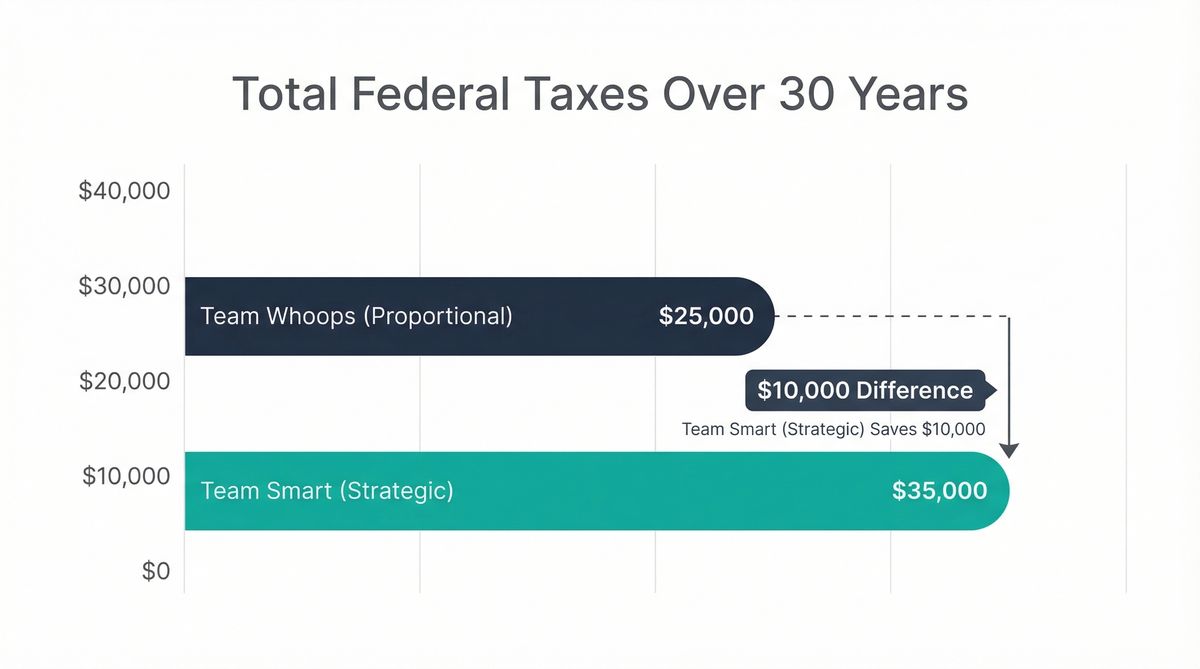
The damage: $90K in unnecessary taxes. And that's before counting the extra tax-free growth on the Roth conversions.
Factor in the additional tax-free growth and you're easily looking at $100K+ difference.
Your Step-by-Step Retirement Withdrawal Order Game Plan
Alright, here's the tax-efficient withdrawal strategy that'll put you ahead of 90% of retirees:
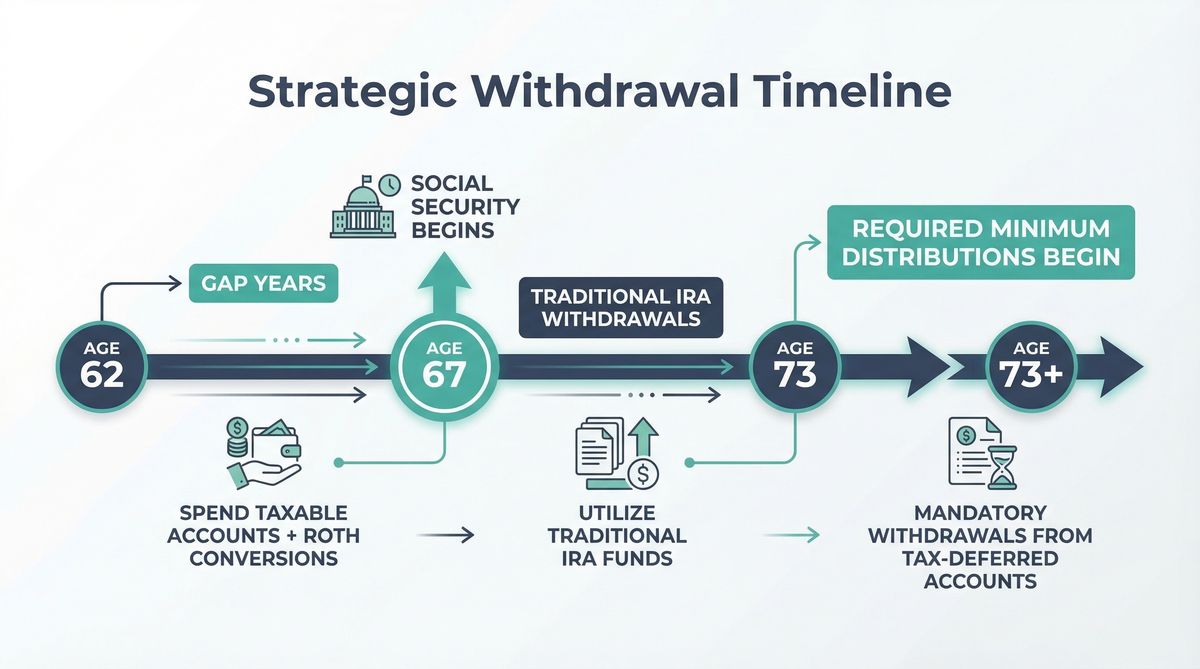
Step 1: Map Your "Gap Years"
Figure out when you're retiring versus when Social Security and RMDs kick in. These low-income years are your secret weapon for implementing the optimal retirement withdrawal order.
Step 2: Prioritize Taxable Accounts During the Gap
Burn through your brokerage money while your income is low. You'll pay minimal capital gains (maybe 0%) and stop the dividend tax bleeding.
Step 3: Convert to Roth During the Gap
Fill up those low tax brackets (10% and 12%) by moving traditional IRA money to Roth. Don't go nuts and jump into the 22% bracket unless the math still works.
Step 4: Switch to Traditional IRA Once Social Security Starts
Use your pre-tax money to supplement Social Security. Since you already shrunk the balance through conversions, you control your taxable income.
Step 5: Use Roth Strategically
Keep it growing tax-free as long as possible, but don't be afraid to tap it in specific years to dodge income thresholds that'll cost you.
Step 6: Watch the Tax Traps
A few income levels will bite you hard when planning which retirement account to withdraw first:
- Social Security taxation: For married couples, if your "provisional income" (basically AGI + half your Social Security) stays under $32K, none of your Social Security is taxed. $32K-44K and up to 50% gets taxed. Over $44K and up to 85% is taxable. These thresholds haven't moved since 1993, which is criminal.
- Medicare IRMAA: If your income hits $206K (married filing jointly in 2026), your Medicare premiums jump. Each tier costs hundreds to thousands more annually.
- Net Investment Income Tax: The 3.8% surtax on investment income when your AGI exceeds $250K (married).
The beautiful thing? Roth withdrawals don't count toward any of these thresholds. It's like having invisible money.
Important Considerations for Your Retirement Account Withdrawal Sequence
Look, I'm simplifying here because real life is messier than spreadsheets:
State taxes are all over the place. Some states don't tax retirement income at all. Others will grab whatever they can. Know your state's deal before finalizing your tax-efficient withdrawal strategy.
Tax laws change. The current "lower" brackets under the Tax Cuts and Jobs Act are supposed to expire after 2025, which actually makes Roth conversions more attractive right now.
Healthcare subsidies matter. If you're retiring before 65 and buying insurance through healthcare.gov, your income affects your premium subsidies. Too much conversion income could cost you thousands in lost subsidies.
Your situation is unique. Your spending, health, state, legacy goals — it all matters for the optimal retirement withdrawal order.
What You Should Do Right Now
If retirement is on the horizon — or you're already there — here's your to-do list for implementing a tax-efficient withdrawal strategy:
First: Inventory everything. List every account, balance, and tax type. You can't optimize your retirement account withdrawal sequence if you can't see the whole picture.
Second: Find your gap years. When do you retire? When does Social Security start? When do RMDs begin? That gap is pure gold for minimizing taxes in retirement.
Third: Run some quick math. Even a basic comparison of "withdraw equally" versus "spend taxable first + strategic conversions" will show you what's possible.
Fourth: Get help if the stakes are high. If you've got over $500K in mixed accounts, proper withdrawal sequencing can easily pay for professional advice many times over. Find someone who actually understands this stuff — not just someone who'll put you in target-date funds and call it a day.
The gap between "good enough" and "optimized" is often 50 to 100 grand over a 30-year retirement. Your money worked hard to get where it is. Make sure it's working smart on the way out.
🎯 Your Next Steps for Tax-Efficient Withdrawals
- Map your timeline: Identify your retirement date, Social Security start, and RMD beginning. Mark those "gap years" for planning.
- Inventory your accounts: List every account with balance and tax treatment (taxable, traditional, Roth). You need the full picture.
- Model the scenarios: Compare proportional withdrawals vs. strategic sequencing. Even rough math will show the difference.
- Consider Roth conversions: If you're in those low-income gap years, calculate how much you can convert at 0%, 10%, or 12% tax rates.
- Get professional help: With $500K+ at stake, proper planning pays for advice many times over. Find a tax-aware retirement specialist.
Peace!
At Ready Aim Retire, we're obsessed with helping people keep more of their own money instead of accidentally donating it to the government. Want to model your own withdrawal strategy? Check out our free retirement calculator — no email required, no sales pitch, just solid planning tools.